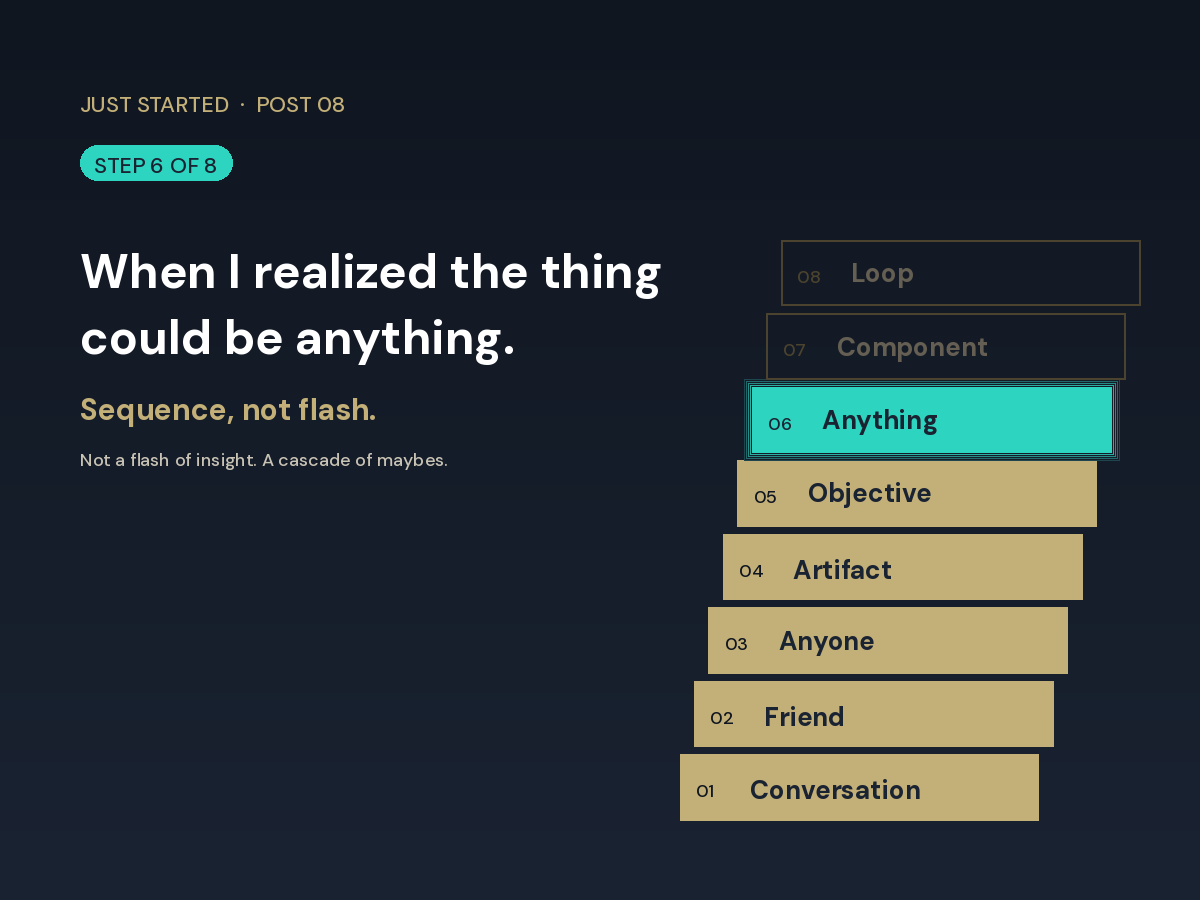
When I realized the thing could be anything.
Step 6 of 8: from knowledge base to interview to score to app.

By Step 5 the AI was producing strategies, briefs, calendars, decks. All of it better than I would have written it, faster than I would have produced it. All of it still paper. The categories were the categories I had specified my whole executive career.
Step 6 is where the categories opened. Not in a flash. In a sequence of small maybes.
For some time before this, I had been working with Claude on my own retirement readiness plan. Not as a product. As a personal exercise. I was still at Dell, still running the day job, and April 1 — the day I would actually leave — was on the horizon. I was preparing for the transition the way I knew how: by getting clear on where I actually stood before I had to figure it out in real time.
The arrangement was simple. I had pulled together the research and popular thought around happiness and longevity across the six dimensions — Health, Wealth, People, Place, Passion, Purpose — and used that material to take an honest look at where I was on each one against where I wanted to be a year or two ahead. Claude was the research partner. I asked it to summarize the literature. I asked it to challenge my self-assessments. I asked it to push back when I was being soft on myself. That was the whole arrangement. It was useful, but it was still me running the show. The AI was a librarian. I was the questioner.
Then I had a thought.
Maybe Claude could use that knowledge to interview me, instead of me interviewing Claude. Start with Health. Hand it the research. Tell it the dimension. Have it ask me where I actually am — directly, conversationally — and use what I say to assess where I sit against what the literature would call ready versus exposed.
That was the first maybe. It was not a leap. It was an inversion. Same knowledge, same dimension, same AI — just facing the other way. Instead of me being the questioner, the AI was. Instead of the AI being a librarian, it was an interviewer.
We tried it. It worked. The interview produced a more honest read on Health than the self-assessment had. That made the next thought thinkable.
So I had the next thought.
Maybe I could standardize this. Build the same interview process across all six dimensions. One conversation per dimension. One way to come out the other end with a coherent read on where I am.
That was the second maybe. Now Claude was not just an interviewer for Health. It was an interviewer for a system of six. The AI’s role had shifted again.
Then the next.
Maybe I could automate the whole thing. Have Claude run the six interviews, score each one against the literature, and pull the six scores together into a high-quality status report. Not a spreadsheet. A document a person could read and recognize themselves in.
Third maybe. The AI was now an interviewer, a scorer, and a writer of a coherent multi-dimensional report. None of those roles had been on the table when this started.
Then the last one.
Maybe the report doesn’t have to be a document at all. Maybe the whole thing could be an app. Something a person opens, walks through, and comes out the other side with their own profile — and eventually, the beginnings of a real plan.
That was the maybe that took the work off paper.
What had actually changed
Read in reverse, none of these maybes was a flash of insight. Each one was a reasonable next thought from the position the last one had put me in. The knowledge base made the interview thinkable. The interview made the score thinkable. The score made the multi-dimensional report thinkable. The report made the app thinkable.
What had changed across the four maybes was not the AI. It was what I was willing to ask the AI to be.
In the first arrangement, the AI was a research assistant. That role was familiar. Every executive I had ever known had worked with somebody like that. Easy to imagine. Easy to specify.
By the fourth maybe, the AI was the interviewer, the scorer, the multi-dimensional analyst, and the surface a real person would eventually meet. None of those roles were ones I would have thought to specify on day one. I had not arrived at them through vision. I had arrived at them by letting each successful step show me what the next step could be.
I want you to notice what that is and what it isn’t. It isn’t a moment of breakthrough. It is a willingness to keep asking, after each maybe worked, what the next maybe could be. The cascade is the thing. The cascade is what “anything” actually meant. Not anything in a flash — anything across a sequence.
What it changed
The cascade I had just walked through was the pattern. Once I had seen it work, I could not unsee it. Every time I sat down to build the next piece of TRS, the question I started with shifted: not what should this artifact be, but what is the next maybe?
What I had been missing was not the technology. The technology was waiting. What I had been missing was the next maybe. I had been thinking inside the categories I knew — documents, decks, sheets — and stopping there.
Where it broke down
The apps work. The interviews work. The scoring works. The reports read well. But the apps still need me to know what is supposed to happen on the inside of them. The AI builds the surface. I tell the AI what the surface is for.
The next maybe, the one I am inside now, is whether the AI can make some of those calls itself — not just to build the experience, but to participate in it. To notice things. To recommend. To be a participant in the conversation rather than the architect of an empty room.
That is Step 7. I will get to it next week.
There is a version of this story that is about technical capability — the AI can build apps now, look at what is possible. That is true and it is not the part that matters.
The part that matters is what the cascade did to the question I was asking. The first maybe sounded ambitious to me. By the fourth, it sounded obvious. The size of the question I was willing to ask had moved. The categories of things I was willing to imagine had grown. The constraint had never really been the tool. It had been my willingness to ask whether the tool could be the next thing.
A question for anyone reading this. What is the maybe you have already had once and never let yourself say out loud? What is the next role you have not yet asked the AI to play?
That is the maybe you have not yet tried.
Dennis
I’ll be interested to try your app when you get it done.