When I realized the AI could make things.
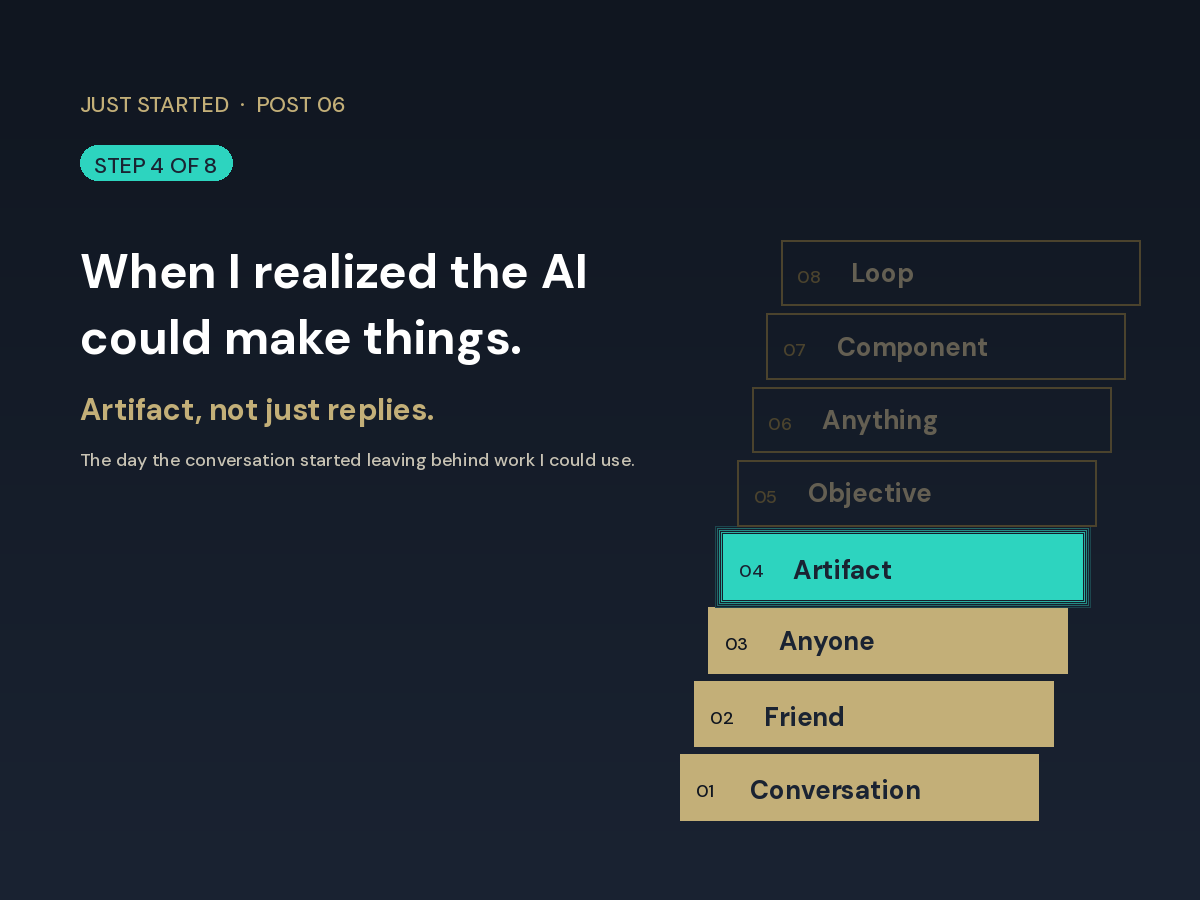
Step 4 of 8: artifact, not just replies.

The specialists were sharp. The output was not yet share-worthy.
I’d built six friends in Step 3, each with its own job. The strategist talked like a strategist. The CIO talked like a CIO. The executive communications consultant could mark up a draft, tell me what was working, hand back a rewrite of a clunky paragraph. The conversations were the best I’d ever had at a desk by myself.
But what came out of those conversations almost always needed work before it was usable. Not the ideas — the ideas were often good. The artifacts.
Anyone who has asked an AI for a formatted document in the last two years knows what I’m talking about. You ask for a memo and get back something that reads like it was written in a markdown editor and pasted straight into the window. Headers set in hash marks. Bullets that render differently depending on where you paste them. Tables that look like tables in the chat and like nothing at all the second you move them into Word or Google Docs. You ask for a deck outline and get back a document. You ask for an email and get back an essay with “Subject:” on the first line and no sign-off. You ask for it in a specific format and the AI says it can do that format, and then produces something that is technically in that format and visually an embarrassment.
Every artifact needed a laundering step. Copy from the chat. Clean up the markdown. Reformat the tables. Fix the headers. Rewrite the parts that sounded like an AI had written them even though what you wanted was something that didn’t. By the time the thing was share-worthy, I had done half the work myself.
So I kept treating the AI like a conversation partner, not a production tool. The artifacts I cared about — the ones that went to other people — I still wrote myself, with the conversation as input. It was faster than writing cold. But it wasn’t the shift I could sense was possible if only the output could be trusted.
The morning the comms consultant produced something I didn’t have to clean up
This was late 2025, still in my last operating role. I had a topic I wanted to put on LinkedIn — a perspective on part of our industry I’d been thinking about for months.
I went into the project I had built for the executive communications consultant. Same specialist as before, same persona brief, same knowledge files about my voice and my context. But this time I asked for something specific: a finished post, in my voice, roughly 250 words, no preamble, no sign-off, formatted as a single block of prose with line breaks where I’d want them on LinkedIn. Ready to paste.
What came back was not ready to paste. The voice was wrong. The structure was generic. The opening line read like every other AI-written LinkedIn post I’d ever seen. I started typing a critique and stopped halfway through, because I realized I was about to spend ten minutes describing what my voice was supposed to sound like to an AI that had no examples to learn from.
So I did something I hadn’t tried before. I went and pulled my three highest-performing LinkedIn posts from the past year, copied them verbatim, and dropped them into the project’s knowledge files. Three posts I had written myself, in my actual voice, that had actually worked. Then I went back and asked for the new post again, with a brief addition: use the three posts in the project knowledge as the reference for voice, structure, and pacing.
What came back the second time was 80% right. There were two clunky sentences and the opening was still a touch generic. I told it what to fix. The third draft was 95%. I edited two words and pasted it.
Start to finish, maybe twenty minutes — most of it spent finding and copying my own posts. No markdown. No laundering. No opening a separate document to clean things up.
That had never happened before.
It was not that the AI had suddenly gotten smarter. It was that I had given it the right material. With a sharp brief, a specific format request, and — most importantly — examples from my own work, the output could come back share-worthy. Not perfect. Not finished. But clean enough that my job was editing, not translating.
Once I had that experience, I started looking for it everywhere. What other artifacts could I get back clean?
The answer turned out to be: most prose artifacts, with enough briefing. A memo. A pre-read. A one-page summary. A follow-up email. A meeting agenda. These were the formats the AI handled well, because they were structurally prose — paragraphs, maybe a list or two, some headers. The markdown didn’t get in the way of prose.
What I still had to launder — decks, anything visual, anything with real tables or layout — I left for later. Those were the artifacts where the AI would insist it could produce what I’d asked for and then produce something that looked like a violation of basic design taste. I went back to building those myself. For a while.
What changed when the artifact came back clean
For the next several weeks I kept doing the same thing with prose artifacts. Different topics, same pattern: brief the specialist sharply, ask for the finished artifact, iterate two or three times, paste. The cognitive load shifted. Writing an artifact required holding its structure in my head until I got it out of it. Editing a clean draft from the AI is a smaller, lighter, faster kind of thinking — every editor knows it’s easier to fix a draft than to write one. What I had stumbled into was a way to give myself a clean draft, on demand, in the formats I most often needed. From there, the work was editing, and editing is fast.
What the AI still couldn’t make cleanly
I should be honest about the boundary as I experienced it at this stage.
The artifacts the specialists produced cleanly at Step 4 were the prose-shaped ones. A post. A memo. An email. A one-pager. A narrative pre-read. The form didn’t change — I was still producing the same kinds of documents I’d been producing for years. What changed was who made the first draft and how much work it took to get the draft into share-worthy shape.
The artifacts that still required me to do the laundering were everything else. Slides. Visual dashboards. Anything with a real table rather than a markdown approximation of one. Anything where the format itself was the medium rather than a wrapper around prose. The AI would say it could produce them. It produced them. They looked bad. I went back to making those myself.
Step 4 is the small but consequential move from the AI helps me make a thing to the AI makes the thing, cleanly enough to share, in the formats where the AI can do that today. Those formats happened to be mostly prose. The rest came later, and it’s further up the staircase.
Step 4’s artifact is the clean draft itself — produced by the AI, owned by me, available the moment the conversation ended, usable without a laundering step in between. There’s a ceiling on what that gets you, and I started to bump into it within a week of working this way.
Where it broke down
Here is the new friction at the end of Step 4, the thing that pulled me toward Step 5.
I was producing more, and producing better, and producing cleanly. But I was still asking for one artifact at a time. A post on Monday. A memo on Tuesday. A pre-read on Wednesday. Each request was a small specification: here’s the topic, here’s the audience, here’s the form, here’s the angle.
And while I was doing that, I was carrying something else in my head that the AI had no access to: the strategy the artifacts were serving.
The post on Monday was meant to land an idea I’d been working out for weeks. The memo on Tuesday was meant to set up a conversation I knew was coming on Friday. The pre-read on Wednesday was meant to nudge a decision in a direction I had spent months thinking about. None of that was in the AI’s hands. All of it was in mine. So I had to walk into every session and brief the artifact in isolation, even though the artifact was part of a larger plan.
What I started to want was for the AI to have the plan. Not just the artifact’s shape. The strategy.
If the AI had the strategy, I wouldn’t have to spec each artifact one at a time. I could ask for a series of artifacts that serve the strategy — and trust the AI to figure out what each one should be.
That’s Step 5. I’ll get to it next week.
Faster drafts, more output, fewer hours. That’s the productivity argument, and all of it is true. But what I think about, when I think back to those first weeks of getting share-worthy artifacts out the door without a laundering step, is something quieter.
I had been treating the drafting as if it were the valuable work. The thinking, the framing, the choices about what mattered — those were the valuable work. The drafting was the place where the thinking became visible to me. As soon as I could get a clean draft from somewhere else, the thinking happened in editing, where it had probably belonged all along.
The labor I had been doing was not the labor I had thought I was doing. The actual labor was the editorial judgment, the yes-this-no-not-that, the call about what the audience needed to hear and how. That work was still mine. It was always mine. The drafting had been getting in its way.
A question for anyone reading this.
What artifact have you been making by hand — because the AI’s first pass always needs laundering — that might come back clean if you briefed it sharply enough? What share-worthy thing are you still carrying from conversation to document and cleaning up yourself?
That’s the artifact you haven’t asked for yet.
Dennis