When I realized the AI could be my friend.
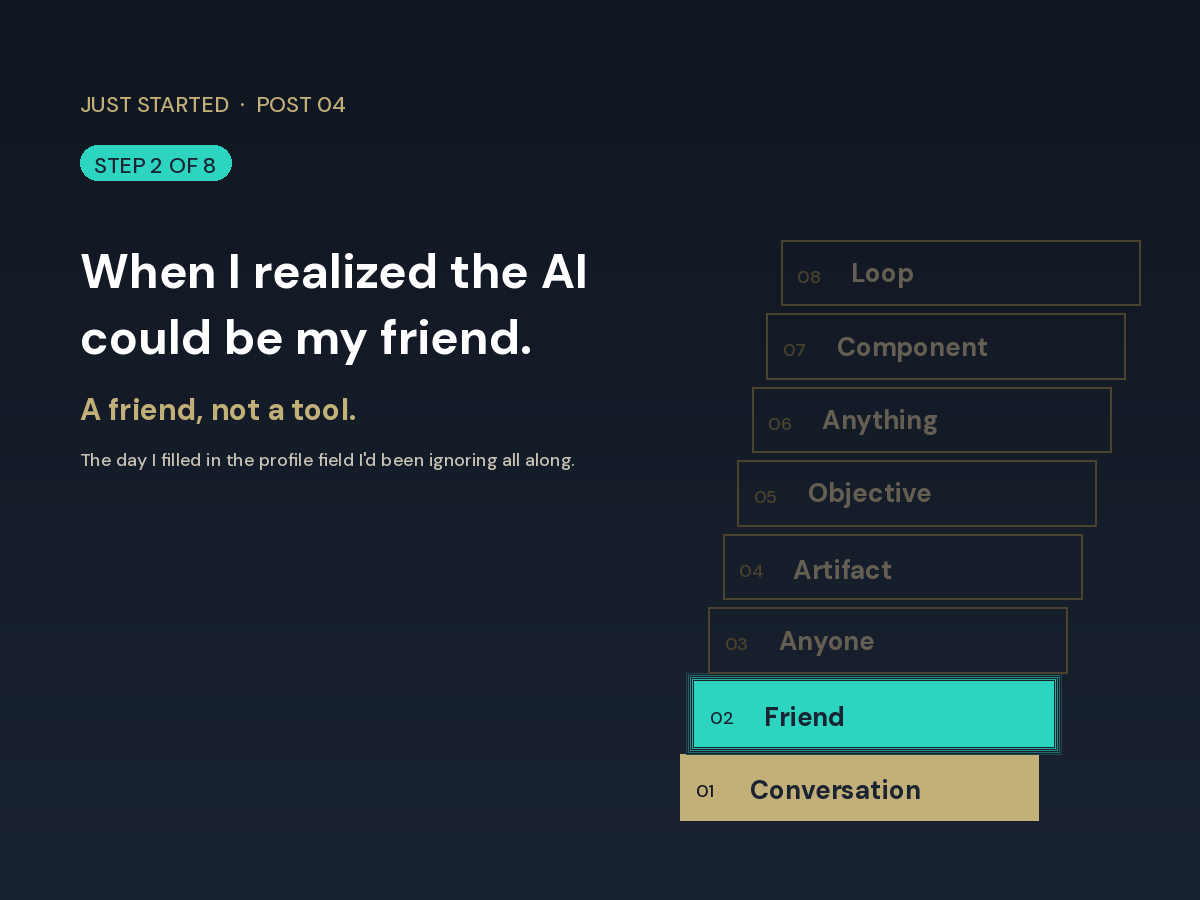
Step 2 of 8: a friend, not a tool.

The conversations were smart but impersonal.
I’d describe a problem in detail, get a genuinely useful answer, and then have to describe the same problem again in the next conversation. And the one after that. The model had no memory of me. Every session started from zero.
For a while I worked around it. I’d paste in background at the top of each session. A paragraph about the product. A sentence about what stage I was in. It helped, but it was manual, and it meant every conversation started with me doing the same administrative work before I could get to the actual work.
This is the friction I described at the end of last week’s post. The model was smart. It just didn’t know me.
The fix I stumbled onto wasn’t something I planned. It was something I got tired of not having.
The afternoon I stopped re-explaining myself
This was still in my last operating role — well before the product, well before any of the work I do now. I’d been deep into something I was wrestling with, making real progress, when I had to step away. When I came back and opened a new session, I spent the first fifteen minutes re-establishing what we’d already established. The context. The constraints. The decisions we’d already made.
Those fifteen minutes made me angry in a productive way.
I didn’t want to carry the context. I wanted the model to carry it. I needed a way to install the background once — who I was, what I was working on, what I’d already decided — so that every conversation started from a shared foundation.
Here’s what I didn’t know at that point: the tool had already built this feature. There was a field, in settings, where I could put a profile that traveled into every conversation. A master prompt. It had been there the whole time. I just hadn’t noticed it, because I was still treating the tool like a search engine that happened to talk back.
I spent an afternoon filling in that field. Not a paragraph — a document. My name, my background, the work I was doing and why, the voice I write in, the decisions already locked, the things I was still working out. A profile, effectively. Not unlike a client intake form. A way of saying: here is who you’re talking to, so we don’t have to spend the first ten minutes on introductions.
The difference was immediate. The first conversation after I filled in that field felt like picking up a thread with someone who had been working on the same problem all week. The model referenced things from the profile without my prompting it to. It gave me specific recommendations instead of general frameworks because it knew my specific situation. When I pushed back on something, it pushed back with knowledge of what I’d already decided and why, instead of just accommodating me.
The AI could remember me now. Not in a magical way — in a structural one. The remembering lived in a settings field, but the effect was something I hadn’t felt from a tool before: I didn’t have to be a stranger every time I came back.
That’s when the word that came to mind changed. The model stopped being a tool. It started being something closer to a friend. A friend knows who you are without being reminded. A friend picks up where you left off. A friend has context.
That’s the artifact at this step. Not a document or a report — a profile. A file that lives outside the conversation and travels into every conversation. The first thing I made that changed how I worked rather than just what I produced.
What an artifact actually is
I should say something about the word.
An artifact, in this context, is anything the model produces that you can hold, share, use, or build on top of. A document. A spreadsheet. A plan. A script. A profile. An outline. A piece of code. Anything that persists beyond the conversation.
The jump from Step 1 to Step 2 — from conversation to artifact — sounds small. It isn’t.
When you’re having a conversation, you’re in the moment. When you have an artifact, you’re outside the moment. You can look at it. Revise it. Hand it to someone else. Bring it back to a different conversation. Use it as the starting point for something that didn’t exist before.
This is where the thought partner framing from Post 2 starts to become real. A thought partner who only lives in the session is limited. A thought partner who produces work that outlasts the session is categorically different.
The profile was my first artifact. Once I understood the pattern, I started making others: a voice guide that described how I write; a decision log of things I’d already figured out; a structure document for whatever I was working on. Each one was a way of externalizing knowledge I had been holding in my head, so that the model could carry some of it with me.
A thing that the better writers about AI keep saying is that the model is a mirror, not an oracle. I think that’s right but incomplete. When you start making artifacts, the model is a mirror that remembers. The conversation becomes a collaboration across time — between the Dennis of this session and the artifacts produced by the Dennis of last Tuesday’s session.
That’s a different kind of tool. And it changes what you reach for.
What it unlocked
Two things, immediately.
First: my working sessions got shorter and sharper. The re-establishment at the top of every conversation shrank to nothing. The work itself took up more of the time.
Second: the outputs got specific. Generic answers happen when the model is compensating for context it doesn’t have. When it has the context, it doesn’t need to hedge. It knows what kind of recommendation I want, what constraints apply, what I’ve already tried. The answers felt like they were for me, not for a category of person I loosely fit.
Neither of these is dramatic. They compound over time. After a few weeks of working this way, I realized I was going faster not because any single session was faster, but because the cumulative overhead of re-establishing context every time had quietly disappeared.
Where it broke down
Here is the new friction that came with Step 2, the thing that eventually pushed me toward Step 3.
A friend who knows who I am is good. A friend who knows my whole life is better. The profile I’d built was static — a single document about me, in a single field, applied to every conversation. It didn’t matter what I was working on. It didn’t matter who I was talking to inside the tool. The same paragraph showed up. The same intake form. One friend, who knew me in general, but didn’t know what I was up to today.
What I started to want was a different kind of friend for different kinds of work. The friend who knew the product I was building. The friend who knew my writing voice. The friend who knew the technical problem I was wrestling with on Tuesdays. Each one with its own background, its own focus, its own memory of what we’d been doing together.
A single profile couldn’t be all of those at once. What I needed was the ability to have many friends — each one specialized, each one tailored, each one ready to pick up exactly where we’d last left off.
That’s Step 3. I’ll get to it next week.
There’s a version of this story that’s about technology. But when I think back on that afternoon — the angry fifteen minutes, the profile I built in a single sitting, the session the next morning that felt so different — what I think about is something simpler.
I’d been treating a remarkable tool like a stranger I had to introduce myself to every morning.
That’s not a technology insight. That’s a human one. And I think it’s available to anyone who gets tired enough of re-explaining themselves to tools that should, by now, remember who they are.
A question for anyone reading this.
What do you re-explain about yourself every time you open a new window? Your role. Your voice. The thing you’re trying to do. The decisions you’ve already made and don’t want to defend again.
That’s the profile you haven’t filled in yet. And it’s the difference between a tool that doesn’t know you and a friend who does.
Dennis
Just Started is a weekly Monday essay by Dennis Hoffman about what it actually looks like to build with AI tools after a long career in something else. The Retirement Strategy (theretirementstrategy.ai) is the ongoing experiment this publication documents.