When I realized the AI could be anyone.
Step 3 of 8: many friends, not one.

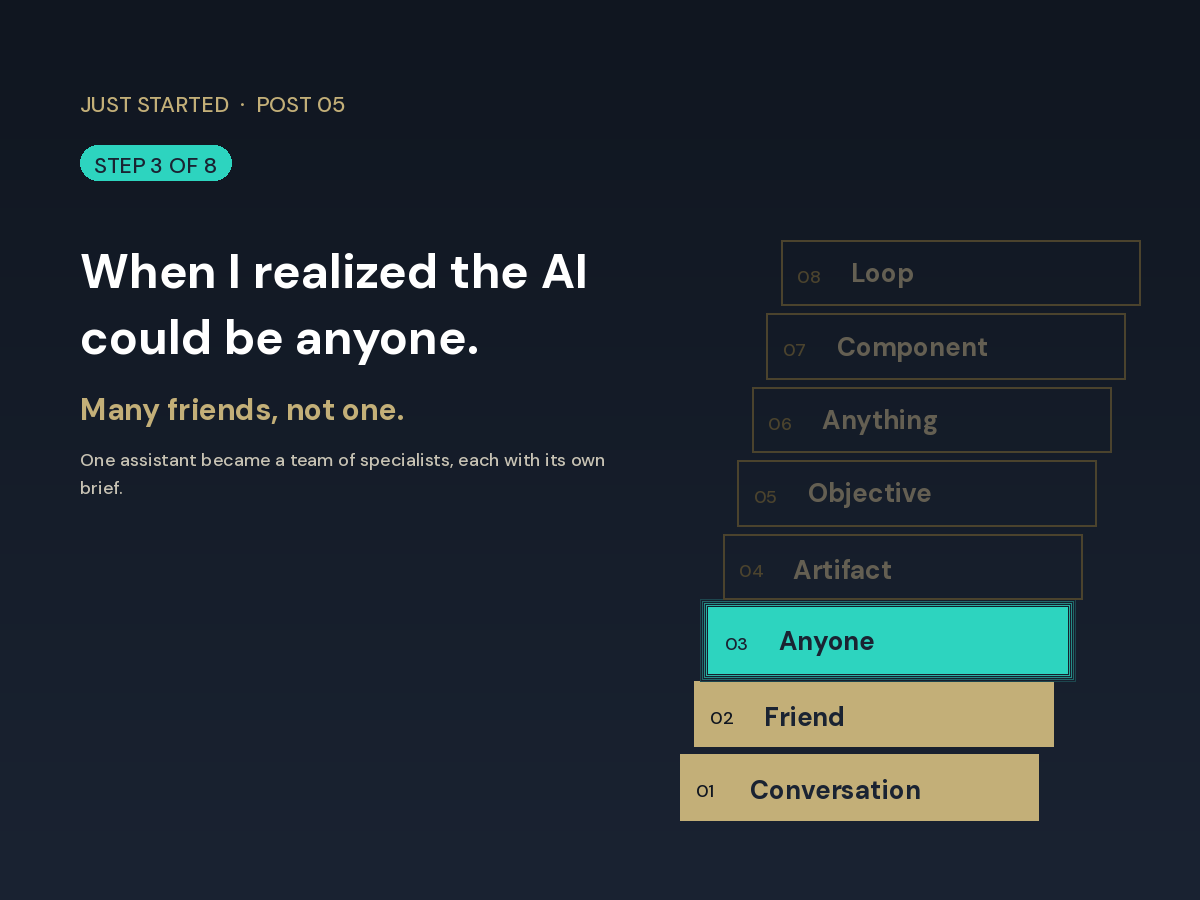
The friend was good. The problem was that one friend was being asked to be everything.
In the operational role I had at the time, I was using my new profile-equipped AI for almost everything that crossed my desk. Drafting a memo. Working through a strategic question. Editing something for a colleague. Talking through a personal financial decision after work. Thinking about a health question on a Sunday afternoon.
Same friend. Same context file. Same paragraph at the top of every conversation about who I was and what I cared about.
The friend was patient. The friend was smart. The friend would do whatever I asked.
But the friend was a generalist. Asked to be a strategist on Tuesday morning, an editor on Tuesday afternoon, a financial advisor on Tuesday evening, and a doctor’s-office-translator on Tuesday night. The same overhead at the start of every conversation: here’s the new role I want you to play today.
I started to notice it most when the work got harder. The strategy work got vaguer when it followed an editing session, because some part of the friend was still in line-edit mode. The financial work hedged in a way that felt like consultant-speak rather than CIO directness. The medical questions got the bedside-manner answer instead of the here’s what the data says answer. Different jobs wanted different voices. The single friend couldn’t be all of them at once without dilution.
The morning I built six friends
This was still pre-product, well before The Retirement Strategy. I was at my last operating role. The different tools all had a version of the same feature — projects, tasks, gems, workspaces, call them what you will. The idea is the same: set up a specific instance of the AI with its own instructions, its own background files, its own focus. A profile per role, on top of the global profile that described me.
One morning I built six.
Three for work:
An executive communications consultant. Drafts and edits to my voice. Knows the difference between a pre-read for a small group and a kickoff for a large one. Hard on filler. Strict about what gets cut.
A chief of staff. Operational sequencing, pre-reads, follow-through. Asks the second-order question. Schedules the audit I would have skipped.
A chief strategy officer. Sees the chessboard. Pushes back when I’m describing a tactic as if it were a strategy.
Three for personal:
A chief investment officer. Reads my financial situation and the broader market with the same eye. No hedging. No “you should probably consult a professional” at the end of every answer.
A general counsel. Explains the risk in a contract or a decision the way a real GC explains it to a CEO — plainly, with implications named.
A chief medical officer. Translates a doctor’s note, a lab result, a treatment option. Not bedside-manner reassurance. Real interpretation.
Each one got a persona-level briefing — who they were, what their job was, the standard they were holding to. Each one inherited the broader profile about me — my situation, my role, my goals. So every conversation started in the same shared world, but with a different specialist in the chair across from me.
Here’s the part that still surprises me when I think about it: I didn’t write the briefings from scratch. I asked the generalist to help. I want an assistant that plays the role of a chief strategy officer in the context of my work. Draft a project name, a description, an instruction set, and suggest what files I should make available to it.
The generalist I’d built in Step 2 became the scaffolding for the six specialists I built in Step 3. Each step made the next step available. That’s the pattern I keep noticing as I climb this staircase — each step isn’t a leap, it’s a small move that the previous step made possible.
The first time I used them, the work felt different in a way I hadn’t anticipated.
It wasn’t that the answers got smarter. It was that the answers got cleaner. The strategist sounded like a strategist. The CIO sounded like a CIO. The general counsel didn’t soften the bad news. Each conversation stayed in its lane, and the lanes were narrower and deeper than the single-friend setup had ever produced.
The thing I didn’t expect: parallel conversations
The unexpected gift of having six friends instead of one was that I could talk to several of them at the same time.
Not literally simultaneous — but close. I could have a strategy question open with the CSO in one tab, a draft with the executive communications consultant in another, and a financial check-in with the CIO in a third. Each conversation persisted independently. Each one had its own thread, its own working context, its own ongoing project.
I was no longer doing one piece of work at a time. I was doing three or four pieces of work in parallel, with three or four specialists, and switching between them the way you’d switch between a 1:1 with your strategy lead, a chat with your communications head, and a ten-minute check with your CFO. Different conversations, different paces, different stakes.
That’s not how I had ever worked before. Not at any company, at any level. The teamworked that way — multiple specialists with multiple workstreams running in parallel, coordinated by me. But I had never had access to that kind of working pattern as a single person, sitting at a single desk.
This is the thing I want to be specific about. The leverage wasn’t in any single answer. The leverage was in the architecture. Six narrow specialists, each with persistent context, working on different problems in parallel, each available the moment I had a question.
What an artifact actually is, again
Step 2 introduced the idea of an artifact — something the model produced that lived outside the conversation. The profile was the first one.
Step 3’s artifact is a different kind of thing: not a single document, but a role. Each specialist friend is, structurally, an artifact. They persist between sessions. They carry their own background. They have a stable identity. You can hand them a piece of work and they remember who they are while doing it.
A role is an artifact in the same way a job description is an artifact. It outlasts the moment of its creation. It shapes the work. It tells the inhabitant — human or otherwise — what they are supposed to be doing and why.
This is what I think the staircase is really about, by the way. Each step is a way of making the AI into a more durable, more usable, more structural piece of how you work. Conversation persists for the length of a session. A profile persists for the length of a relationship. A role persists for the length of a project. Each step is more durable than the last.
We are not yet at the end of that progression.
Where it broke down
Here is the new friction at the end of Step 3, the thing that pulled me toward Step 4.
The friends were good. The friends were specialized. The friends could work in parallel. But the friends were still mostly talking to me. The output of a conversation with the strategist was advice. The output of a conversation with the CIO was a recommendation. The output of a conversation with the executive communications consultant was a marked-up paragraph or a suggested rewrite.
All of that was useful. Most of it lived in the conversation window.
What I started to want, especially as the work got bigger, was for the friends to actually make things. Not say things — make things. A finished memo, not a critique of my draft. A scheduled plan, not a suggested approach. A document I could use as-is, not a transcript I had to mine for the parts that were useful.
The conversation was sharp. The output was not yet portable.
That’s Step 4. I’ll get to it next week.
There is a version of this story that’s about software features. Projects. Persona instructions. Role-level context. Those are the technical names for what I built that morning.
But when I think back on the change, what I think about is something more human — and something I want to be careful not to overstate.
I have had decision-ready analysis in my career before. We all have. It shows up when you find, or develop, a person who can give it to you: the strategist who returns a question in the shape of a real answer, the CFO who has already considered the counterfactual, the chief of staff who brings you the sequenced plan and not the discussion of whether to plan. When you find one of those people, you cherish them. You hold onto them.
What was new that morning wasn’t that I had access to decision-ready analysis. It was that I could create people who produced it. Six of them, in a morning, faster than I could have developed a single human in months. Better? I don’t know. But faster and cheaper, for sure.
That changes the math. Not on any single question, but on the whole day. When decision-ready analysis is rare, you save it for the most important questions. When you can spin it up at will, more of your work gets that treatment. Decision-making velocity goes up. Productivity goes up. Not because anyone typed faster, but because the input to every decision arrived closer to ready than it used to.
That’s the shift, at Step 3. Not access to specialists — I’d had that before. The ability to make them.
A question for anyone reading this.
Who are the specialists you’ve cherished in your career — the ones whose analysis arrived already useful? What would it mean to be able to build one of them this afternoon, for a job you’re doing badly or partially by yourself right now?
That’s the friend you haven’t built yet.
Dennis
Very useful. Again.