When I realized I was about to build a glorified form.
Step 7 of 8: not just built with AI. Built with AI inside it.

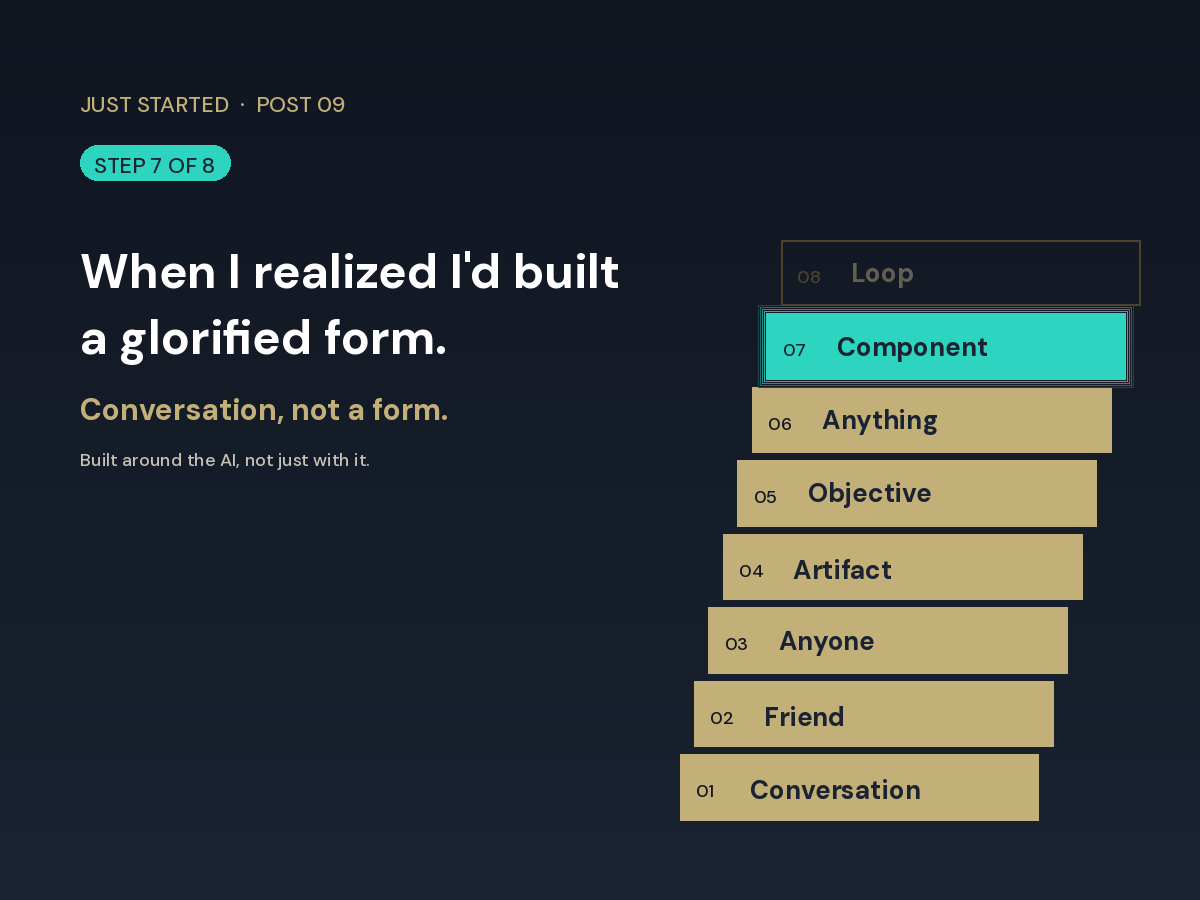
Step 6 ended with a working system. The cascade of maybes had produced something a person could open, walk through, and come out the other side with a profile across six dimensions and the beginnings of a plan. It was real. It worked. I could have shipped it.
Step 7 is when I noticed I had been about to ship the wrong thing.
This was March 2026. The launch date I had picked for the first version of The Retirement Strategy was March 31.
The first week of March I had been away on an international business trip, a full week of meetings and travel that pulled me entirely off the build. I came back with distance I had not had before. A week of not looking at it had been enough to let me see it again as a stranger would.
What I saw was a competent, decent, soon-to-ship retirement-readiness product.
It was also, if I was honest, not particularly different in kind from the products already in the market.
There are several retirement-planning tools out there today. Some are pretty. Some are automated. Some are very detailed. They walk a user through a sequence of dimensions, or questions, or considerations. They produce a status read. They suggest a set of next steps.
The underlying structure is the same in every case.
They are forms. Multiple choice, check boxes, the occasional open-response field. Fundamentally a list of questions.
A glorified form is still a form. The artifact is a record of the answers. What it does not capture is the conversation around the answering.
I had spent weeks of nights and weekends building a smarter form. The AI had been the builder — it had helped me design the surface, write the interview, score the dimensions, draft the report. But the artifact I had built was, structurally, the same kind of artifact those other tools had built.
That was when I had the next maybe.
The maybe that changed the shape
Maybe the AI didn’t have to just live in the toolchain. Maybe it could also be embedded in the product itself. Maybe the AI wasn’t only the builder. Maybe it was also the surface.
The difference is harder to see from outside the work than it is from inside it. Built with AI meant the AI was in the toolchain — helping me make the thing. Built with embedded AI meant the AI was also in the experience itself — the user talking to it, the user’s words part of the artifact. The toolchain placement didn’t go away. The new placement was where the product became a different kind of thing.
Two things follow from that decision that did not follow from the smarter-form decision.
The first is that today is the worst the product will ever be. A form released today is approximately as good as it will ever be — the questions are fixed, the flow is fixed, the math is fixed. A product with AI embedded inside it gets sharper as the models underneath it get sharper, as the prompts get refined, as the use accumulates. The slope of the product over time is different.
The second is that the system captures something a form cannot capture. When a user finishes a dimension on a form, the record is: user said 7 out of 10 on Health. When a user finishes a dimension inside a conversation, the record is: user said 7 out of 10 on Health, and here is what they said about why, here is what they pushed back on, here is the specific worry they named when the AI asked what they were actually afraid of. The score is one number. The conversation around the score is everything else.
I made the call.
The remainder of March was the work of rebuilding what I had so the AI sat at the center of the experience, not just inside the toolchain that produced it. The interview, the scoring moment, the closing screen — all of it had to be reworked to put the AI in the room with the user rather than behind a curtain.
The product that launched on Tuesday, March 31 — version one of TRS — was not the product I had been about to launch when I left for the trip three weeks earlier.
April 1 was my last day at Dell.
What it became
The artifact was no longer a smarter form. It was a conversation. The user was not filling something out. The user was talking to something. The data the system was collecting was not a column of scores. It was language — in the user’s own words, about what they were actually wrestling with.
That is what embedded AI gave the product that built with AI never could.
The next maybe
Once embedded AI was running, there were two ways the product could keep getting sharper.
The first was the model itself. Every few months, a more capable reasoning model would come out, and the AI inside the experience would just become more capable with it — better at conversation, better at reasoning, better at picking up on what someone was actually saying. That improvement happened on its own, without me touching anything.
The second was specific to this domain. A general-purpose model could have an excellent conversation about retirement on day one. What I started to want was a way for it to get sharper at this in particular — at the patterns this cohort was showing, at the questions that kept coming up, at the responses that had been working and the ones that had not. The intelligence the model brought was general. The work it was doing was specific. There was a way to close that gap.
Maybe the AI could get smarter — not just in general, but about this.
That is Step 8. I will get to it next week.
There is a version of this story that is about AI features inside products. That is true and it is not the part that matters.
The part that matters is the realization that the AI didn’t have to just live in the toolchain that built the product. It could also live inside the product itself. That is a different product. That product has a different slope, a different data shape, and a different ceiling.
Denni
s