When I realized I didn't have to specify what — only why.
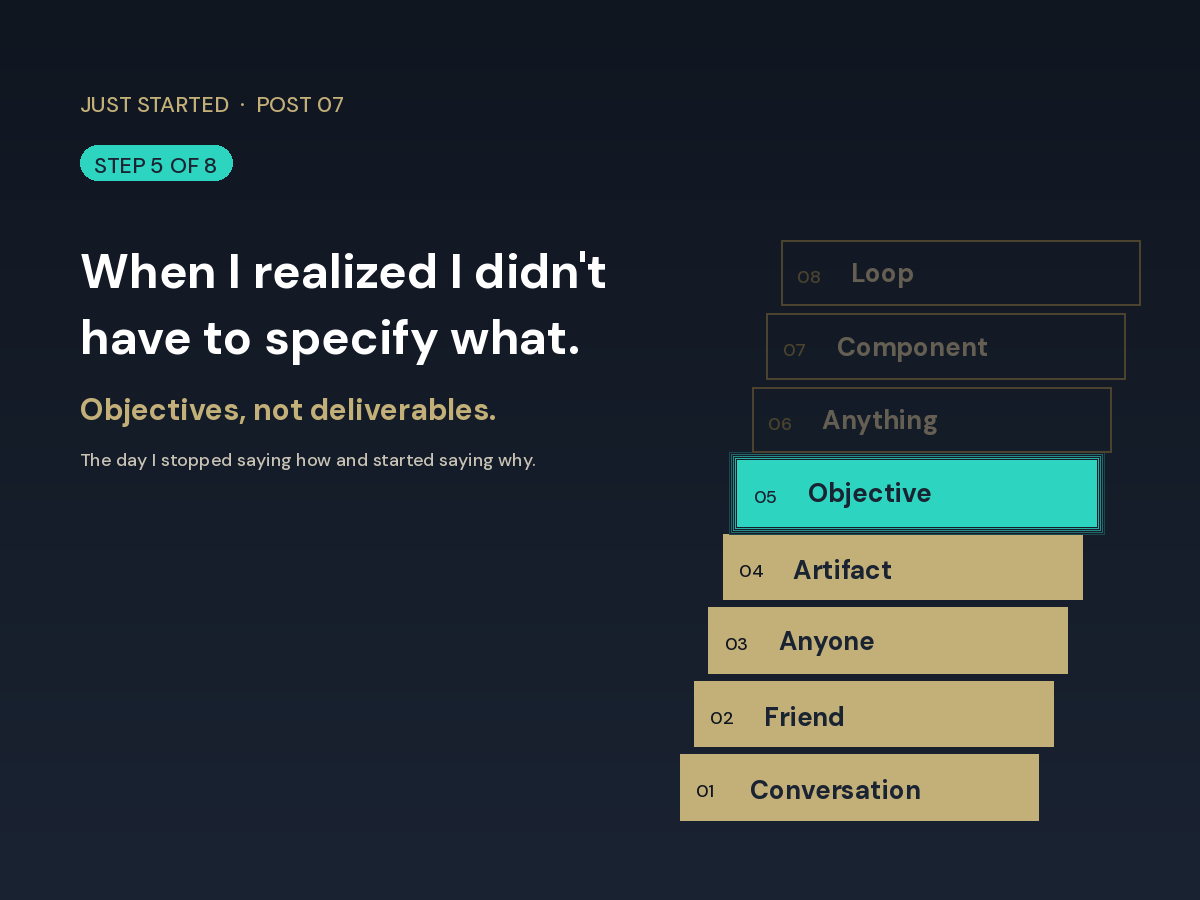
Step 5 of 8: objectives, not deliverables.

Step 4 ended where last week’s post ended: clean artifacts on demand, from sharp briefs. Faster output. Better drafts. Less laundering.
What I didn’t notice for a few weeks was that the work hadn’t really gotten lighter. I was producing more, but I was also specifying more, and the specifying — every brief, every angle, every form decision — was its own piece of writing. The drafting work had moved out of my head. The strategy work had stayed in.
The plan was carrying me, and I was the only one carrying the plan.
The morning I asked for the strategy instead of the post
This was still late 2025, last operating role. There was a topic I cared about — a perspective on our industry I’d been putting on LinkedIn one post at a time, in isolation. Some posts were landing. Some weren’t. I had a sense of where I was trying to go but no document that captured it.
I went into the project for the executive communications consultant — same specialist, same persona, same knowledge files including the three high-performing posts I’d added in Step 4. But this time I didn’t ask for a post.
I asked for a comms strategy.
Specifically: given my role, my audience, the perspective I’ve been building, and the posts in the project knowledge, draft a complete communications strategy for the next quarter. Treat LinkedIn as one channel among several. Tell me what the goal is, who we’re trying to reach, what the through-line of the messaging is, and how the channels work together.
What came back was a real strategy document. Not a post outline. A page and a half of structured thinking — audience segments, message pillars, channel role definitions, sequencing principles, success metrics. Some of it was right. Some of it was generic. The audience analysis was sharper than I would have expected; the metrics were soft and needed work.
I didn’t accept it. I worked it. I told it where I disagreed, what I wanted to add, what I thought it had wrong. It revised. I pushed back again. After three or four passes, what was on the screen was something I would have signed off on if a real comms team had brought it to me.
I saved it into the project’s knowledge files. I called it the strategy. I closed the conversation.
The next morning, the part that surprised me
I came back the next day with a different ask. I told the AI to use the strategy in the project knowledge as the reference. Then I said: develop the LinkedIn portion of this strategy. Treat the strategy as the brief. Produce what you think the LinkedIn part of executing this strategy should look like.
I assumed I would get posts. That’s what the LinkedIn portion of the strategy had said it would include. Posts, scheduled, in a reasonable cadence.
What I got was not just posts.
What I got was:
A calendar for the next several weeks, laying out what would publish when.
Narrative arcs — not a list of post topics, but threaded story arcs that each spanned multiple posts and built toward specific ideas I wanted to land.
Post sequences, grouped by arc, each one positioned in the calendar.
Specific post timing, by day and by time window, based on when my audience was most likely to read.
A posting rhythm that balanced frequency against fatigue, with deliberate pauses and tonal variation.
Bylined article companions for the strongest arcs — extending the ideas into long-form where the LinkedIn format couldn’t hold them.
A target publication list for those articles, ranked by fit and by reach within my intended audience.
Outreach emails to the editors at those publications, written in the register an editor would expect.
I had asked for the LinkedIn portion of a strategy. I had assumed I’d get posts.
It blew me away.
I had not asked for a calendar. I had not asked for narrative arcs. I had not asked for timing windows or posting rhythm. I had not asked for bylined articles or a target publication list or the outreach emails that would go with them.
The AI had read the strategy and decided, on its own, that those were the pieces a competent comms execution would produce. Not as disconnected deliverables — as a coherent plan, structured the way a real comms team would have structured it, with the through-lines between the pieces already drawn.
It was right on most of it. I pushed back on some of the timing, adjusted a couple of arc framings, and cut one of the target publications as a bad fit. Everything else landed as proposed.
What had actually changed
Nothing technical had changed about the AI. It was the same model, in the same project, with the same persona instructions and the same knowledge files. What had changed was how I was specifying the work.
In Step 4, I was giving the AI deliverables — a post, this length, this audience, this angle.In Step 5, I gave it an objective — execute the LinkedIn portion of this strategy. I didn’t specify the form. The AI chose the forms it thought would best serve the objective. The cognitive load shift in Step 4 was drafting → editing. In Step 5 it became editing → directing.
Step 5’s artifact is the strategy document itself — the page-and-a-half I’d worked through with the AI and saved into project knowledge before any of the deliverables got produced. That artifact is what made everything else possible. What you make at one step becomes the brief for the work at the next.
Where it broke down
Here is the new friction at the end of Step 5, the thing that pulled me toward Step 6.
The package was good. The strategy was real. The artifacts conformed. But everything I’d produced — even the surprises — was still in a format I would have produced anyway. A calendar, in a doc. Posts, as text. A presentation, as a deck. Articles, as drafts. Emails, as emails.
What I started to want, especially as I got more comfortable describing objectives instead of deliverables, was for the AI to make things in categories I hadn’t asked for at all. Not just to produce a calendar — to produce something that behaved like a calendar but was alive, updatable, queryable. Not just to produce a doc — to produce something that did what the doc was trying to do, but in a form that didn’t have the limits of a doc.
I had been working with the AI as if its only outputs were the kinds of artifacts that fit on my desk. The friction was that some of what I now wanted to make didn’t fit on a desk.
That’s Step 6. I’ll get to it next week.
There is a version of this story that’s about delegation. He learned to delegate to the AI.That’s true, but it’s not the part that matters.
The part that matters is what got delegated. It wasn’t the work. It was the choice of what work to do. For my entire career, the people I worked with executed against deliverables I had specified — even when the deliverables were sound, the act of specifying them was mine. The strategy, the sequencing, the choice of what artifacts to produce in service of which objectives — that was the part of the work I had always carried alone.
Step 5 was the first time I handed any of that to a system that wasn’t a person.
A question for anyone reading this. What instruction have you been giving the AI that you could replace with a goal? What deliverable have you been specifying when what you really care about is the outcome the deliverable was supposed to serve?
That’s the brief you haven’t written yet.
Dennis