When I realized I could keep talking.
Step 1 of 8: conversation, not search.

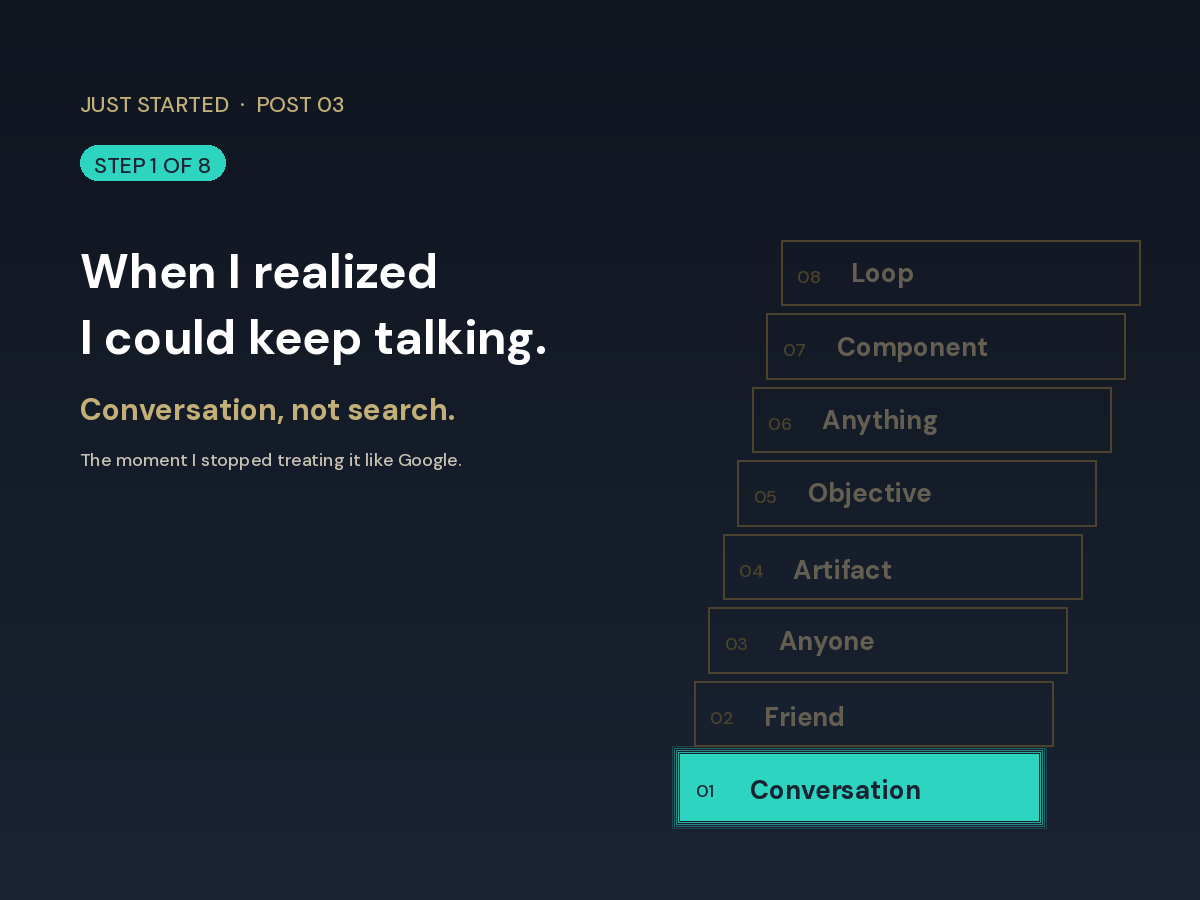
When I realized I could keep talking.
Step 1 of 8: conversation, not search.
Published: Monday, May 11, 2026, 7:00 AM MT
Cover: juststarted_post03_step1_cover.png (staircase graphic, Step 1 lit teal, Steps 2–8 muted)
The first thing I used it for was the thing everyone uses it for.
I had a question. I typed the question. I read the answer. I closed the tab.
That’s the search habit. I’d been running it since 1996. Google changed the form slightly — you typed keywords instead of sentences, you sorted through ten links instead of reading one answer — but the underlying move was the same. Question in, answer out, close the window, move on.
What I didn’t notice for the first several months of using Claude is that the window didn’t have to close.
The thing that’s different about a conversation
In the spring of 2025, I was working through a specific operational problem in my last operating role. Not strategic — operational. We were trying to figure out how to automate a process that was eating significant team time, and I was using Claude to think through it the way I might have used a consultant call. I typed the problem. I got a framework. I closed the tab.
Then, a few weeks later, working on a different version of the same problem, I typed a follow-up question. Not a new question — a follow-up. I wanted to go one level deeper on something the answer had implied.
The model remembered. Not in some mysterious way — I was still in the same conversation window — but it built on what had been said rather than starting from scratch. It treated my follow-up as a continuation, not a new query. And then it asked me a clarifying question I hadn’t thought to ask myself.
That was the moment.
Not the answer it gave. The question it asked.
It asked because I had kept talking. Because I hadn’t closed the tab. Because I was in a conversation now, not a search.
What conversation actually does
When you search, you retrieve.
When you converse, you think.
The difference sounds semantic. It isn’t. When I was searching — question in, answer out — the model was serving me what it knew. When I was conversing, the model was surfacing what I was already half-knowing but hadn’t yet said out loud.
The thing that conversation does, that no search ever does, is hold the thread.
A conversation remembers that I said, twelve messages ago, that the problem was really about two things, not one. It remembers that I agreed with a point and disagreed with another. It builds on the context I’ve given it rather than starting fresh with each exchange. And because it’s holding the thread, it can notice when something I say in message fourteen is actually a more interesting version of what I was trying to say in message two.
This is what I mean when I say the artifact of Step 1 wasn’t a document or a plan or a product. The artifact was my own thinking, made legible. Conversation produced something I couldn’t have produced alone — not because the model is smarter than me, but because it forced me to articulate what I thought until the articulation got clear enough to be useful.
Questioning makes you find what you think you know. Conversing makes you find what you actually think.
The experiment
That operational problem I was working on in spring 2025 took several conversations across several weeks. By the third conversation, the model had enough context that it was asking me questions I hadn’t asked myself. By the fifth, it was pushing back on an assumption I had baked in from the beginning — one I’d never examined because I’d just inherited it.
The assumption turned out to be wrong. Or at least incomplete. We ended up solving a slightly different problem than the one I had originally typed.
That would never have happened in a search. A search gives you what you already know to look for. A conversation gives you what you didn’t know you needed to find.
My team started doing the same thing, independently. I’d walk into a meeting and someone would have worked through a problem in Claude before the call — not to get an answer, but to figure out what question they were actually asking. The prep had changed. The questions in the room had gotten sharper.
We weren’t talking about it. We were just doing it. Conversations that didn’t close when we got an answer.
What it unlocked
The tool stopped being a reference and started being a relationship.
Not a relationship in the sentimental sense. A relationship in the working sense — the way you develop with a colleague over time. You stop explaining the backstory. You reference things that have already been established. You push back more confidently because you have a shared history of pushback-and-revision. The conversation has a texture that individual queries don’t.
Once I understood this, I stopped using single-shot questions for anything that mattered. Every real problem got a conversation. Every piece of work got a thread.
Where it broke down
Here’s the friction that comes with Step 1, the thing that pushed me toward the next step.
The conversations kept being too general.
I’d get a framework when I needed a recommendation. A set of options when I needed a decision. A thorough answer to the wrong version of my question because the model had no way to know which of a hundred contexts I was actually in.
The model was smart. It just didn’t know me.
What I needed wasn’t more conversation. It was a way to give the conversation context — to tell the model who I was, what I was working on, what I’d already decided. A profile. A set of instructions. A project.
That’s Step 2. I’ll get to it next week.
The thing the advice almost gets right
“Just start” is terrible advice. I’ve said that twice already in this publication, and I’ll keep saying it, because handing someone that phrase and walking away is the laziest kind of mentorship.
But here’s what the phrase gets right, almost by accident.
Once you change the first verb — once you stop searching and start conversing — you don’t have to plan the next step. The next step finds you. The conversation keeps going until the generality of it frustrates you, and the frustration is the thing that pulls you toward Step 2. You don’t sit down one morning and decide to add context. You get tired of repeating yourself, and context shows up as the obvious fix.
That’s the part that’s true. The ball does start to roll. You do just have to follow your nose.
What’s false is the idea that the ball starts rolling on its own. It doesn’t. Something has to tip it. For me, that something was the day I didn’t close the tab.
A question for anyone reading this.
When did you realize you could keep talking instead of closing the window? What happened in that conversation?
I’m asking because I think this is the most underdiscussed part of the whole AI-fluency thing. Everyone talks about prompting — the right words to use in the question. Nobody talks about the conversation that follows the question. But that’s where the actual work happens.
Tell me what you found on the other side of the tab you almost closed.
Dennis
Just Started is a weekly Monday essay by Dennis Hoffman about what it actually looks like to build with AI tools after a long career in something else. The Retirement Strategy (theretirementstrategy.ai) is the ongoing experiment this publication documents.
This is interesting and I’m glad you dug into it a bit, as I’ve found it to be true as well, even if I deployed the conversational aspect unconsciously. Now I’ll be more conscious about it as a conversation and see where that takes me. I’ve actually got an interesting problem I’m working on with a friend who owns a bakery that I might test out with Gemini. It involves the very manual task of folding (and then unfolding) boxes to hold pastries sent to a farmer’s market.