The pyramid I didn’t know I was climbing.
The seven rungs of AI use, and the one grammatical shift that separates the people who use these tools from the people who build with them.

Last week I told you the story of the Saturday morning I opened Claude Code for the first time and typed a paragraph that turned into a product. I argued that “just started” is useless as an answer because it hides three ingredients: a year of small asks with the tool, an idea I’d been quietly carrying, and a specific kind of meta-question.
This week I want to go back to the first of those ingredients — the year of small asks — and tell you what was actually happening. Because when I look at it now, I wasn’t doing one thing. I was climbing a pyramid. I didn’t know it at the time. Nobody named the rungs for me. I want to name them for you, because once you can see the pyramid you can see where you’re standing on it, and that alone changes what you do next.
The seven rungs
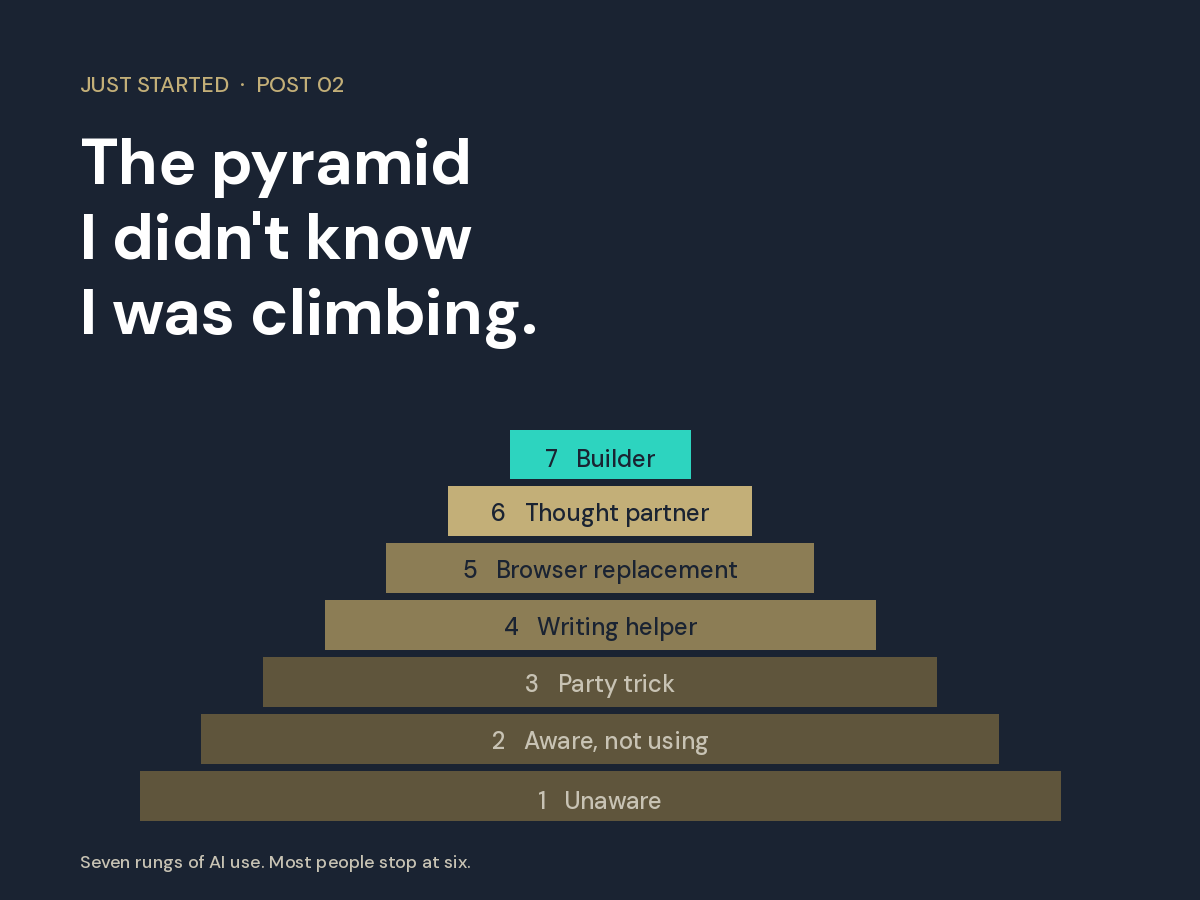
Here is the pyramid. Read it from the bottom up.
1. Unaware. You don’t know what’s there. This is most of the world, still. Every time I say “Claude” to someone my age they say “Claude what?” That’s rung one. No judgment. You can’t use a tool you haven’t heard of.
2. Aware, not using. You know it exists. You’ve seen the headlines. Maybe a colleague mentioned it. You haven’t touched it. Something — time, fear, the sense that it’s not for you — keeps you off. Most educated professionals over fifty are on this rung right now.
3. Party trick. You’ve tried it. You asked it for a haiku about SPAM. You asked it to rewrite something in the voice of a pirate. You laughed. You showed someone. You closed the tab. You have the anecdote — “oh yeah I’ve played with it” — but not the habit.
4. Writing helper. This is the first rung where it starts to matter. You use it to fix an email. Tighten a paragraph. Summarize a long document. Draft a first pass of something you didn’t feel like drafting. It saves you time in small doses. It hasn’t changed how you think. It’s a better spellcheck.
5. Web browser replacement. You stop opening Google for a whole category of questions and you open the AI tool instead. “What’s the capital of Bhutan.” “How do I unclog this valve.” “What’s a 1031 exchange.” You get an answer in a paragraph instead of a page of blue links. You don’t cross-check every time. You notice, if you’re honest, that the results feel better than Google’s.
6. Thought partner. This is the rung where the tool becomes a relationship, not a utility. You bring a messy problem. You say here’s what I’m wrestling with, here’s what I think is going on, here’s what I’m not sure about, help me think through this. The exchange takes twenty minutes, not twenty seconds. You push back when the tool is off. You acknowledge when you’re lost. You end up with something better than you would have arrived at alone. You start noticing that some of your best thinking of the week happened in that window.
7. Builder. The single-threaded questions stop. Prompts stop starting with who, what, when, where. They start starting with build, create, draft, design, make. You stop asking the tool for information and you start commissioning it to produce something. A product. A plan. A document. An app. A website. A series. A whole thing.
The shift between 6 and 7 is grammatical
That’s the part I missed for most of the year.
The jump from rung six to rung seven isn’t about using the tool more. It’s not about a better prompt. It’s not about a subscription tier. It’s about the verb at the start of your sentence.
Can we discuss this. What should I think about here. Help me work through this. Those are thought-partner verbs. They assume you are the one doing the work, and the tool is there to think with you.
Build this. Draft this. Create this. Design this. Make this. Those are builder verbs. They assume the tool is doing the work, and you are there to direct it.
Most people don’t cross that line, and they don’t know the line exists. They stay on rung six forever, getting smarter conversations out of the tool, and they conclude that they’ve figured out what AI is for. They have not. They have figured out what rung six is for, which is a lot, but it’s not rung seven.
The people who are building the wave of products you’re starting to see coming out of solo operators — retired executives, former teachers, post-career professionals in their fifties and sixties — are people who crossed from six to seven. They didn’t do it by becoming more technical. They did it by changing the verb.
The Saturday was my crossing
I’ve been telling you, for two emails now, the story of a February Saturday when I opened Claude Code and typed a paragraph asking whether my retirement framework was a good use of the tool’s capabilities. That paragraph is a rung-six move. Can we discuss and refine a detailed approach. It’s a thought-partner question.
But the two hours after that paragraph — the back-and-forth that turned the discussion into an outline, the outline into a specification, the specification into code running on my laptop — was a rung-seven experience. Somewhere in the middle of that Saturday the verbs changed. Let’s build. Draft this. Create this piece. I wasn’t interviewing the tool anymore. I was directing it.
I had been sitting on rung six for most of 2025 without knowing it. I didn’t have a word for it. I just knew that my conversations with Claude had gotten longer and more substantive and that my team had started doing the same thing independently. When I look at that year now, I see six people together, on rung six, quietly getting fluent, none of us knowing that rung seven was an option.
The Saturday was the day I took a step up without planning to. The step wasn’t technical. It was grammatical.
The proof is in the second prompt
I didn’t tell you the whole story last week. There was a second prompt that same Saturday.
The first prompt, the one I walked you through last week, was the paragraph asking whether building a retirement advisor was a good use of Claude’s capabilities. Claude spent the next stretch of that morning interviewing me through the framework, teasing out where I was strong and where I was thin on my own retirement readiness. It was the best intake conversation I’d ever had about my own life. I was still in thought-partner mode — rung six — and I was getting a lot out of it.
A few hours later, still the same Saturday, I typed this second prompt:
I see a market opportunity and would like to work through it with you. Observation: an internet search for “Retirement Strategy” yields 99% “Wealth Management” information. So I built a retirement strategy framework with an ultimate objective of happiness (attached). This came from backsolving from unhappy retirees I know. After the first six months of “every day is Saturday” and “I’m on permanent vacation”, they seemed to get pretty depressed. I think that’s because the people, place, purpose part of their world revolved around work and largely disappeared when they retired. Moreover, they neglected their health and subjugated their passion — all for the pursuit of “enough money to retire”. I would like to find a modern, AI-first way to build a little side business helping people avoid that by putting the “same” amount of time, energy and money into the other five elements of my framework that they have in the wealth part. Thoughts about the idea? Ways to build a modern business around it?
Read those two prompts next to each other. Same Saturday. Same person. Same tool.
The first one starts with can we discuss. The second one starts with I see a market opportunity. The first one asks about implementation for me. The second one asks about a business for other people. The first one is thought partner. The second one is builder.
I didn’t notice at the time. I was just typing what came next. But when I go back and look at the two paragraphs side by side, the grammatical shift between them is the whole subject of this essay, happening to me, in real time, over the course of an afternoon I thought was just me playing with an AI on a Saturday.
And notice what the second prompt already contained. A market observation I’d done the search to justify. A customer segment I’d backsolved from. A product thesis — put the same time, energy, and money into the five neglected dimensions. A business model ask — ways to build a modern business around it. All of that came out of me in one paragraph because once you start typing builder verbs, the tool has permission to pull the rest of the thesis out with it.
I called it “a little side business.” The thing I was about to start has become something other than little. The prompt was smaller than the thing it started.
That is what rung seven looks like, up close. Not drama. A paragraph. A change of verbs. Claude doing the work you authorize it to do, instead of the work you keep asking it to think about with you.
Where you are right now
Look at the list again and locate yourself honestly. Nobody’s watching.
If you’re on rung one or two, the move is to get on rung three. Go try it. Ask for a haiku about SPAM. I mean that literally. The party trick is not a waste of time. It’s the first touch. Without it you can’t get to four.
If you’re on rung three or four, the move is to use the tool for something real this week. Not a haiku. An actual task from your actual life. Draft the email you were dreading. Summarize the document you didn’t read. The point is not the output. The point is the groove.
If you’re on rung five, the move is to bring a real problem. Something you’re actually wrestling with. Something you don’t have a clean answer to. Spend twenty minutes on it. Let the conversation go where it goes. See if you end up somewhere you wouldn’t have gotten to alone.
If you’re on rung six — and I suspect many of you are, because the subscribers to this publication are the kind of people who would be — the move is different. The move is to notice, one of these days, that you want to ask the tool for a thing instead of a conversation. When that moment comes, don’t flinch. Change the verb. Say build this or draft this or create this and see what happens.
You don’t have to know what you’re doing. The whole point of rung seven is that you find out by doing.
One thing to try before next Monday
Open your AI tool. Ask yourself: what’s a thing I’ve been meaning to make but keep not making?
Doesn’t matter what it is. A toast for a wedding. A business plan for an idea you half-have. A speech. A spreadsheet. A letter you owe someone. A website for something you’ve been thinking about. A chapter. A curriculum. A policy doc. A game. An app.
Then type this, or something like it:
I want to build [the thing]. Before we start, can you walk me through how you’d approach this, what the options are, and what questions I should answer before we begin? Then let’s build a first draft together.
Notice the verbs. Build. Walk me through. Begin. Build a first draft together. That is a rung-seven sentence. Most of you haven’t typed one before.
Type it. See what happens. The point is not the artifact. The point is the step up.
I’ll see you next Monday.
Dennis
Just Started is a weekly essay by Dennis Hoffman about what it actually looks like to build with AI tools after a long career in something else. The Retirement Strategy (theretirementstrategy.ai) is the ongoing experiment this publication documents.