Just Started.
A weekly essay about what it actually looks like to build with AI tools after a long career in something else.

The phrase I’ve said too many times in the last six months is “I just started.”
Someone asks how I went, in a little over a year, from running a large team at Dell to using AI to build software and run a small business with no employees. How does an executive who spent 22 years coordinating people start writing apps? The honest answer is that I just started.
It’s true. It’s also useless.
If you’re the person asking, “I just started” isn’t a story. It’s a wall. You nod, you smile, you say something polite, and inside you think okay, but what does “just start” actually mean when I don’t know where to begin, when I’ve never written a line of code, when the AI thing sounds like it’s for twenty-five-year-olds in San Francisco, when my career was in a different field, when I’ve watched three younger colleagues try this and quietly fail, when I’m not even sure what I’d build, when I’m quietly worried I’m already too late?
You don’t say any of that. Instead you say something like “that’s amazing, I really should look into it,” and you change the subject, and you go home and you don’t look into it. Looking into it means sitting in front of a blank screen with no idea what to type. Nobody tells you what to do at that moment. The moment passes.
I want to tell you what it actually looked like. Because once I say it out loud, “just started” doesn’t sound the way I’ve been using it.
What I was really doing during the year before I “started”
The part of my story I’ve been glossing over is that I didn’t just start. I spent a year getting ready to start without realizing I was getting ready.
It was the spring of 2025. I was still at Dell, still running the telecom business, still working through the specific operational problem of modernizing the division I was responsible for — how to simplify, how to standardize, how to automate, how to apply AI to the key processes that determined whether the business unit worked. How to build better products for bigger customer problems. How to transform telecom with operational efficiency. That kind of work.
Those problems taught me to talk with Claude.
Not as an experiment. Not as a prompt-engineering exercise. As a working relationship. I learned, across that spring and through the year, how to actually have conversations with an AI model. I learned to acknowledge when I was clueless. I learned to ask for help. I learned to tell Claude when it was off track and push back when the response was thin. I learned what it could do well and where it fell over.
By the middle of the year Claude wasn’t just mine. It had become a thought partner for my exec team — a member of the team, in a strange way, not anyone’s assistant but a resource we talked to together. We ran problems through it before we ran them through each other. By the end of the year most of the senior people on my team were doing the same thing independently. None of us announced it. It just happened, as the tool got better at what we needed and we got better at the tool.
In parallel, underneath the work drumbeat, I was hearing a second one. The entrepreneurs and thought leaders I was reading were saying that agentic AI was going to enable something new — the one-person startup. A company without employees. A product without a team. An entrepreneur with an idea and a set of tools.
I was curious. I didn’t have an idea.
The thing I actually had
What I had, before I had a framework, was a sentence running in my head.
There has to be a better way.
I was watching my own retirement coming at me and I could feel that the standard playbook wasn’t going to be enough. At some point I googled “retirement strategy” expecting to find it. What I got instead was buried in articles and videos about when to take social security and how to build a retirement portfolio. Financial planning, dressed up as retirement planning. That was the whole internet on this subject.
My first idea, if you can call it an idea, was just the complaint. Retirement planning is broken. There has to be a better way. I need that better way.
That’s it. That was the whole thing, for a while.
I want you to notice what that is and what it isn’t. It isn’t a product. It isn’t a business plan. It isn’t an insight. It’s a person noticing a gap between what exists and what he needs, and feeling irritated enough about it to keep noticing. Most people have a sentence like that running somewhere in their lives. Most people don’t think of it as an idea. They think of it as a frustration, or a complaint, or a nothing — the thing they grumble about in the car.
The frustration is the idea. You just haven’t given it that name yet.
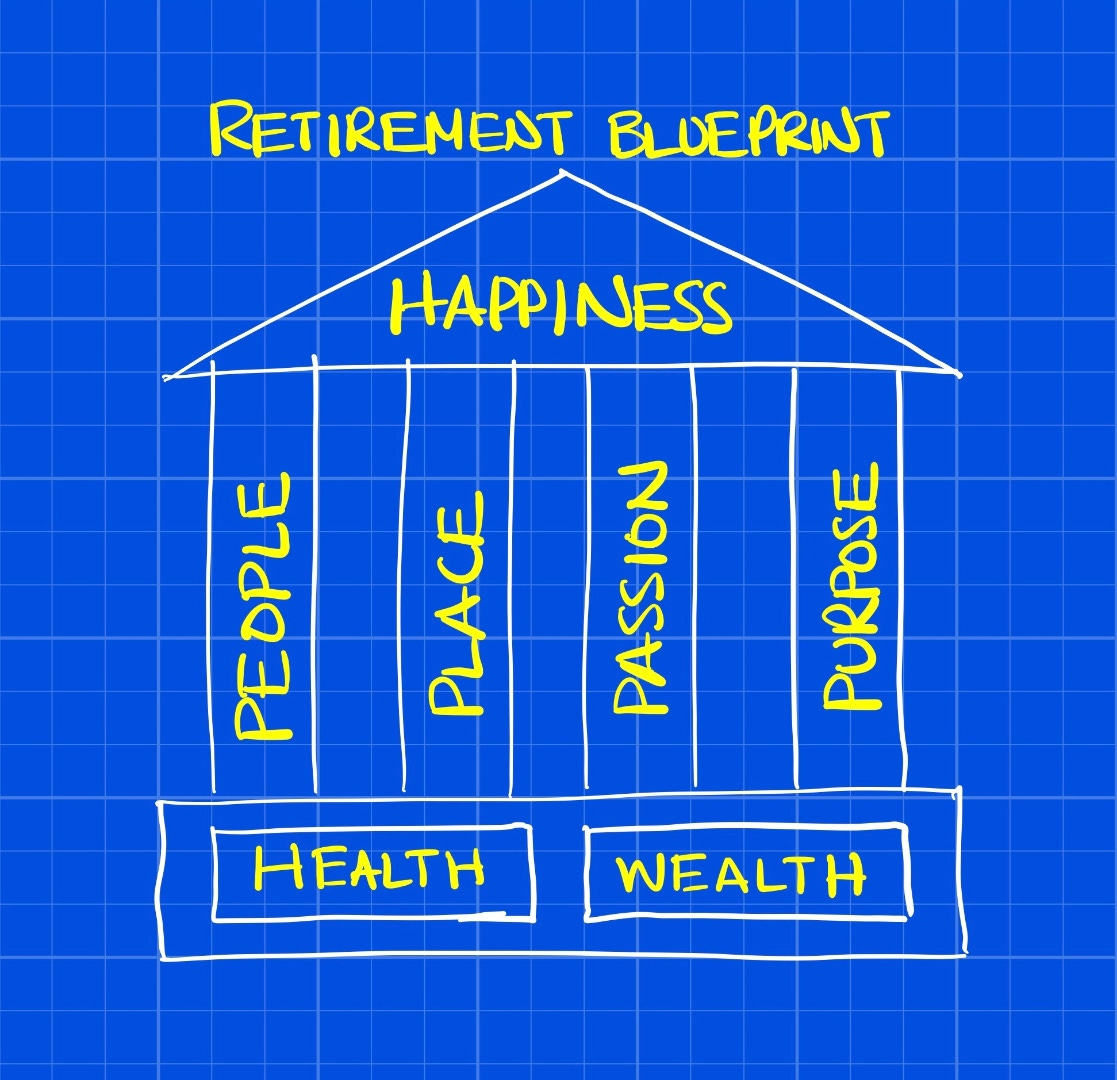
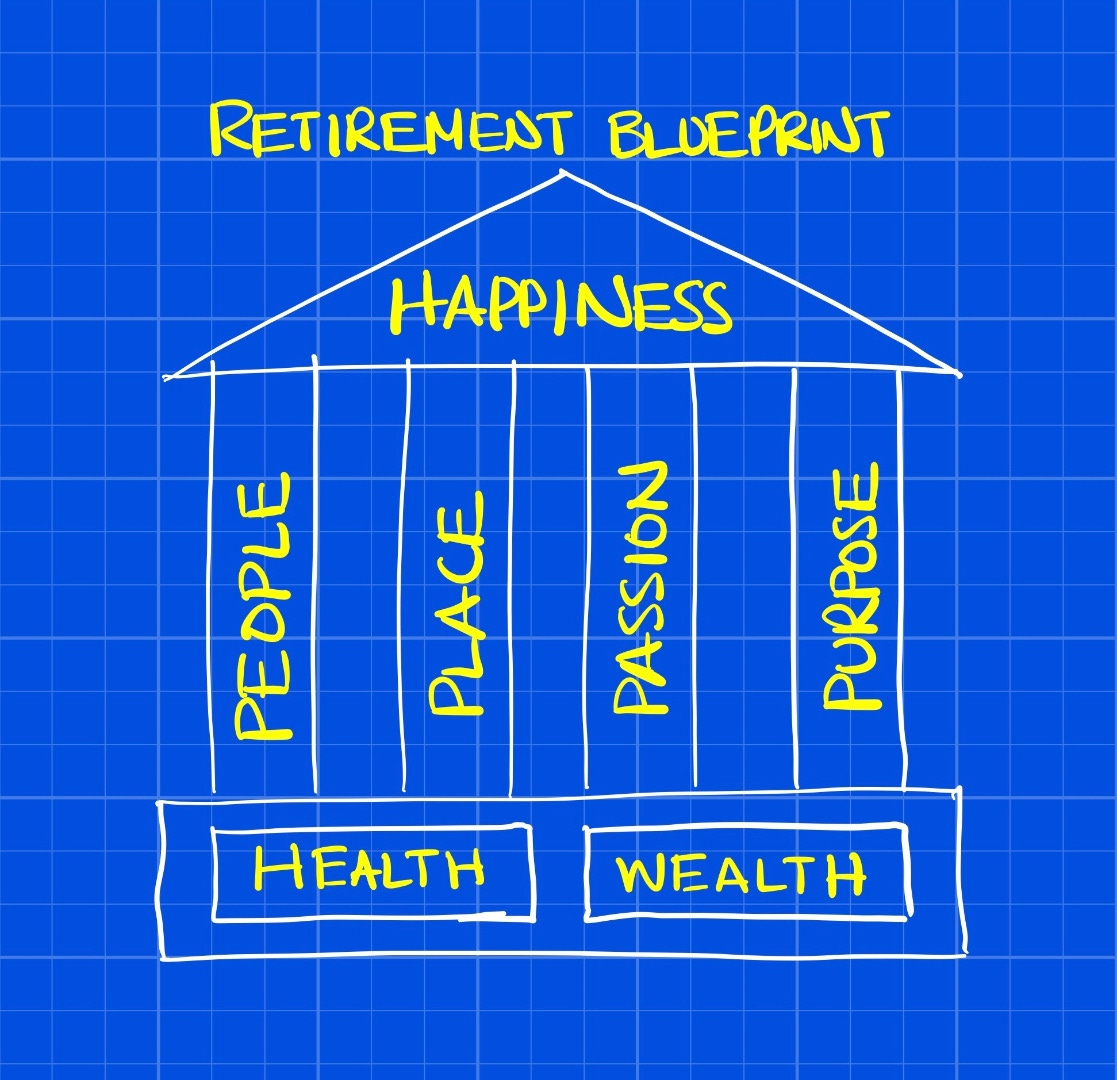
Mine eventually turned into a framework. Across 2024 I kept sketching and re-sketching a way of thinking about my own retirement, and in the back half of the year I wrote it up as a blog post — a hand-drawn image of a house, with Happiness as the roof, People, Place, Passion, and Purpose as the four pillars, Health and Wealth as the foundation. Six dimensions. The argument was that most retirement planning is actually financial planning — just Health and Wealth — and the four pillars that determine whether retirement is a good life get almost no attention.
A few dozen people read it. A few replied with thoughtful notes. I thought about it, off and on, for another year. I didn’t turn it into anything. I had a framework looking for a form.
That is the part of the story that matters. The thing I eventually handed to Claude wasn’t a blank idea I came up with that morning. It was an argument I had been carrying around for more than a year, that had itself come out of a frustration I had been carrying for longer than that, waiting for me to figure out what to do with it.
Most people who say they “just started” did this too. They had a sentence running in their head — there has to be a better way to do this thing — that they had never named as an idea. The moment of starting wasn’t the moment they had a flash of insight. The moment of starting was the moment they finally picked up the complaint they had been carrying and decided to treat it like a question worth answering.
If you’ve been telling yourself you don’t have an idea to start with, I want you to consider that you may be wrong. You may have a sentence running somewhere in your life right now — there has to be a better way to X, why is Y still this hard, why has no one fixed Z — that you’ve stopped recognizing as an idea because you’ve gotten used to carrying it.
The Saturday
On a Saturday in early February 2026, I opened Claude Code for the first time. I took a photograph of the framework image. And I typed this:
Attached is my philosophy/framework for Happiness (the goal) in retirement. I would like your help implementing this framework in my life. Specifically, I’m curious how we might create a retirement advisor that enables me to chat with a single point of contact but parses the work to a parallel team of experts on each part of the framework. I would like to be able to use this as often as I want over the next 20+ years as I age and the world changes, so there needs to be long-term memory. Before setting anything up, can we discuss and refine a detailed approach for implementation? What are the options, pros and cons? Is this a good use of your capabilities?
That’s what I wrote.
I want you to notice what it is and what it isn’t.
It isn’t a polished incantation. It isn’t a demonstration of prompt-engineering expertise. It isn’t a request to build a product. It’s a paragraph asking for a discussion. I wasn’t asking Claude to build anything yet. I was asking Claude whether this was worth building, what the options were, what the pros and cons were, and whether this was even a good use of the tool in front of me.
That last sentence is the one I want you to read again. Is this a good use of your capabilities?
That’s the question I had been too intimidated to ask for most of the previous year. I had been using Claude for discrete tasks — help me think through this problem, help me draft this note, help me understand this thing. I had not, until that Saturday, asked the bigger question. What could this actually be? Is what I’m imagining a reasonable use of what’s in front of me?
The fact that I eventually asked it — after a year of smaller asks — is the actual beginning of The Retirement Strategy. Not the code, not the product, not the launch. The Saturday I asked the big question of the tool I had been quietly getting to know for a year.
The answer Claude gave me, over the next two hours that Saturday, turned into the outline that turned into the product I’ve spent the last three months building.
What “just started” actually means
Read in reverse, my “just started” story has three ingredients that all matter:
One: a year of small asks. The spring-of-2025 Dell work taught me how to work with AI. Without that year I would not have had the fluency or the nerve to ask the big question on that Saturday. The small asks compound, quietly, into something that feels like confidence when the moment comes.
Two: an idea I had been carrying for a long time — first as a frustration, then as a framework. There has to be a better way came before the blueprint. The blueprint came before the Saturday. I hadn’t generated either one in the moment. They were ready because I had been carrying the itch, and then the shape of an answer to it, for longer than I had noticed.
Three: a specific kind of prompt. Not a request to do the thing. A request to discuss whether the thing was worth doing, what the options were, and whether the tool could actually do it. The meta-move. The question most people skip because asking it requires admitting you don’t know what’s possible.
Most people who are stuck are stuck because they have one or two of these ingredients, not all three. They have the carried idea but no fluency with the tool. They have the fluency but no carried idea. They have both but they skip the meta-question and go straight to “build this for me,” and the tool builds something half-right, and they conclude it doesn’t work.
The sequence matters. Fluency first. Then recognition of what you’ve already been carrying — even if what you’ve been carrying is still just a complaint. Then the meta-question.
“Just started” means all three of those, compressed into a sentence, after the fact. That’s why it’s useless when people say it to you. The version that’s actually useful is the version I just told you.
What this publication is
If you’ve been hearing your own version of the voice that told me I was too old, not technical enough, too late to matter — this publication is for me to stop giving you the useless answer and start giving you a useful one.
Every Monday I’ll narrate what it actually looked like to build The Retirement Strategy as a sixty-two-year-old retiree with a year of professional AI experience but no coding background, using tools that didn’t exist three years ago, as a solo operator with no team and no investors. Then I’ll narrate whatever comes next.
The posts will be shorter than you expect. The point is not to make this publication into a thing. The point is to give you, in enough specificity that you can locate yourself inside it, the view of what it looks like when a person like me decided to pick up the idea he had been carrying and ask whether the tool in front of him could help him finally do something with it.
You’ll hear about the pricing decisions I can’t land. The partnership conversations that might change the whole venture. The moments I thought I should quit. The things I keep getting wrong. The tools I use, with specificity — not “AI” in general, but this tool, for this task, in this way, here’s what broke.
I’m writing this for the person who reads everything and doesn’t start. The person who’s bought three books on AI and hasn’t opened them. The person who has the tab open and doesn’t know what to type. The person whose spouse or kids keep asking what they’re going to do next and who doesn’t have a good answer.
You don’t have to build a product. You don’t have to start a business. You don’t have to retire to do this. What you have to do is recognize the idea you’ve been carrying, put your hands on a tool you’ve been quietly getting to know, and ask the meta-question first.
One thing to try before Monday
Two small things, actually.
First: write down, in one or two sentences, the idea you’ve been carrying. Not pitched. Not polished. Just what it is. Most people reading this have one. If you don’t have one, write down the problem you keep noticing — the thing that bothers you when you see it, the gap you keep thinking about. That’s the same thing in a different form.
Second: open the AI tool of your choice. Paste the sentence. Then ask this, or something like it:
I’ve been thinking about this for a while. Before we do anything, can we discuss whether this is a good use of your capabilities? What are the options, pros and cons? Is this actually worth doing?
That’s the meta-question. It takes you sixty seconds. It puts your hands on the keyboard. It doesn’t commit you to anything.
Watch what comes back. See where it goes. Tell me about it, if you want — I read the replies.
Next week I’ll tell you about the pyramid I didn’t know I was climbing — the seven rungs of AI use, and the one grammatical shift that separates the people who use these tools from the people who build with them.
I’ll see you Monday.
Dennis
Just Started is a weekly essay by Dennis Hoffman about what it actually looks like to build with AI tools after a long career in something else. The Retirement Strategy (theretirementstrategy.ai) is the ongoing experiment this publication documents.